

The Department of Economic Development is mandated to provide strategic economic direction to the City and help steer the City as a whole towards the goal to achieve 5% economic growth and to reduce unemployment by 2021.
The Department is also mandated to drive the implementation of the City’s approved economic development strategy which has a longer term horizon beyond the 5% growth target.
The economic development strategy emphasises the following:
- Shift to increased localisation of production – replacing imports through getting firms in Johannesburg and South Africa to become competitive suppliers;
- Shift to increased economic activity in different regions of the City – promoting increased economic growth in regions based on their different profiles and comparative advantages;
- Shift to increased small business and entrepreneurship activity – through increased collaboration with the private sector value-chains and City supported-SMME Opportunity Centres; and
- Shift to increased connectivity with the rest of Africa through increased trade and investment links with the rest of Africa, including targeted development of economic precincts that reflect Johannesburg as the economic hub of Southern and Eastern Africa.
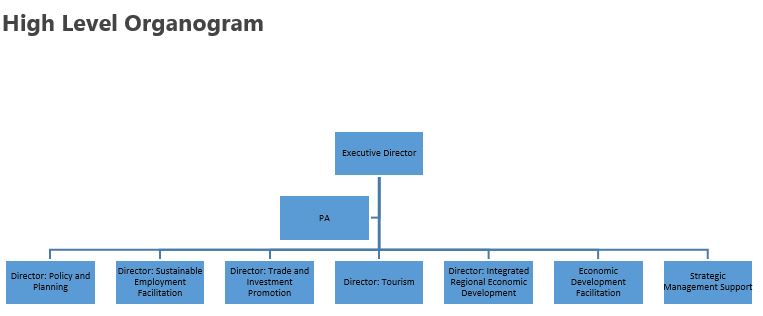
- Support the alignment of City plans and policies towards achieving a 5% economic growth rate and to bringing down unemployment by 2021.
- Support and promote the development of Small Medium Micro Enterprises (SMMEs).
- Facilitate the creation of an enabling environment that attracts investment and provide dedicated incentive packages for investors with a focus on the Inner City.
- Entrenching Johannesburg as a leading tourism destination brand in collaboration with key stakeholders.
- Enhanced collaboration with public and private sector stakeholders.
- Ensure business regulation, compliance and enforcement of the informal trade sector.
- Modelling and Economics to acquire data, develop databases, conduct economic and data modelling and statistical analysis and produce reports on the socio-economic and economic context and performance of the economy of the City.
- Policy Planning to develop economic policies and strategies informed by economic research and the City’s strategic agenda. This includes recommendations on aligning City economic development policies, projects and programmes with those of other spheres of government. Also included in this area is the managing of feasibility studies, resource needs analysis, project appraisal and monitoring and evaluation of identified projects.
- Targeted Sector Strategy Development to formulate sector development strategies to foster economic growth in line with the City’s strategic agenda and economic strategy. This includes sector research and identifying, capturing, structuring, leveraging and sharing information with stakeholders.
- Economic Regulation and Development to research and make recommendations on the impact of laws and regulations on the economic growth and socio-economic development of the City – with particular reference to the City’s desired strategic direction and economic development strategy.
- To develop, increase and support SMMEs to grow their businesses with the aim of creating jobs.
- To reduce unemployment amongst the Youth by offering skills related training, in partnership with the private sector.
- To facilitate growth in the number of Community Based Enterprises and offer them training and development this enabling them to grow.
- To streamline the regulation, support and management of Informal Traders to enable them to run successful businesses.
- The consolidation of City – wide Job Opportunities created through the co – ordination of the implementation of the EPWP
- Investment Promotion, Attraction and Facilitation
- Trade Promotion and Facilitation
- Business Retention, Expansion and After-care
- Investment Tracking and Prioritization
- Facilitate, track and monitor Ease of Doing Business against three Service Delivery Standards
- Develop and promote Investment Incentives and Value Proposition
- Trade Policy research and advocacy
- To create strategic partnerships with the private sector to ensure joint bidding and funding of events and conferences.
- To intensify and build research capacity to be able to proactively bid for conferences and events.
- To implement the marketing campaign.
- To package competitive bidding documents and marketing collateral.
- To support signature leisure and business tourism events.
- To develop a competitive tourism website.
- Entering into Joint Marketing Collaborations with strategic partners in core markets.
- Development of new tourism packages and itineraries
- To provide walk-in Visitor Service Centres where tourists and travellers can obtain various industry brochures, maps and other collateral to promote the product offerings of the destination.
- Participation in Travel Trade/Consumer and Road shows world-wide which provide a platform to promote the destination.
- Hosting of media and trade partners through familiarisation trips.
- Manage and lead the COJ’s Regional economic development and area regeneration initiatives.
- Pursues this objective through the promotion and stimulation of investments and interventions in declining nodes based on the City’s economic strategic direction and agenda.
- Spatial economic transformation required to normalise the COJ’s functioning and build a unified identity.
- Competitiveness of value chains – SMME sector focused and relies on the cluster and value chain methodologies to improve competitiveness
- Improve competitiveness of local capacity –ensuring that identified sectoral projects are sustainable and local capacity is built providing opportunities for skills development and SMME support.
- ensuring adherence to the City’s compliance processes and procedures
- overseeing business planning processes ensuring alignment with GDS, IDP and City’s Institutional SDPIB
- Departmental Performance monitoring and reporting
- Ensuring adherence to the City’s Performance Management System
- Financial management
- Contract management
- MOE Support and Oversight
- Committee’s Coordination
- Administration and logistics including information and records management
Tembeka Mhlekwa
Enquiries
|
Business Licence Officer
Tel: 011 226 8327
|
|
Environmental Health Services Tel: 011 226 8300
Fax: 011 474 6707
|
|
Noise and Air Pollution Control Environmental Health Building
Tel: 011 226 8300
Fax: 011 474 6707
|
|
Metropolitan Public Safety and Emergency Service – Fire Safety Tel: 011 407 6374/5
Fax: 011 339 1532
(R195.00 inspection fee is payable with any new applications)
|
|
Urban Planning Unit Tel: 011 407 6231
Fax: 011 339 3368
|
|
Building Control Unit
Tel: 011 761 0472
Fax: 011 472 3483
|
|
Registrar of Companies Contact the Registrar of Companies to register as a company.
Tel: 0861 843 384
Fax: 0861 843 888
|
|
Liquor licences To apply for a liquor licence, contact the liquor officer at your nearest police station or the Liquor Board:
Matlotlo House
94 Main Street, cnr of Harrison Street
Johannesburg
Tel: 011 355 8099
Fax: 011 355 8083
|
|
Music Rights
You also must apply to the South African Music Rights Organisation (SAMRO) to play any kind of music.
20 De Korte Street
Braamfontein
2001
Tel: 011 712 8000
Fax: 011 403 1934
email: customerservices@samro.org.za
|
|
Street Traders Contact the Johannesburg Metro Police Department (Hawker Unit)
Metro Police Offices
Cnr Village and Loveday roads
Wemmer
Johannesburg
Block F, Room 20
Tel: 011 490 1765/77
Fax: 011 490 1665
|
|
The City’s Policy on Business Licences The City of Johannesburg’s policy is set out in a number of annexures Click here.
|
Hawkers
|
How to run a business in Johannesburg
|
|---|
|
If you are a hawker selling food and meals, which you take from place to place or sell from a vehicle, you need to have a licence.
You will need to apply for a licence from the City’s Trade Licence Department.
In addition, you will need to pay a once-off application fee.
Once the documentation is completed, the application will be forwarded to five departments to check that the following City requirements are met:
Environmental health
Noise and air pollution control
Public safety
Urban planning
Building control
An inspection is carried out of the premises by the departments concerned
Only when all departments have retuned favorable reports and recommend approval the trade license will be issued.
Complete an RP1 form, which can be downloaded or collected from one of the regional offices. This form then needs to be returned with all the necessary supporting documentation: In case of a company, close corporation or partnership a copy of the company certificate and list of directors is required Identity documents for all directors and partners, including that of the manager or person in charge Copy of liquor licence Copy of menu in the case of a food trader Copy of SARS tax certificate Copy of approved building layout plan Zoning certificate Business Licence Office and regulations:
Note that a trade licence or application cannot be transferred with a change of ownership. A business licence can be withdrawn or suspended if there is a failure to comply with endorsements.
A once-off fee is payable at the when lodging your application. Please note, however, that cheques cannot be accepted by Licensing Officers, but can be paid at a council pay point on vote no. 035922517485339.
Environmental Health Building
Cnr Avon Street & Main Reef Road
Longdale (Opposite the Langlaagte SAPS)
Office hours:
7am – 10 am and 3pm – 3.30pm
If reports received from the departments indicate that other requirements need to be satisfied, the Trade Licence Department will send a notice to the applicant. The applicant must comply with the requirements and then arrange a re-inspection with the officer concerned.
The licence will be issued only once all five departments have returned a recommendation for approval.
|
The Tariffs
The City of Johannesburg has amended its Environmental Health Services tariffs with effect from 1 July 2012.
| Service |
Recommended Tariff |
| Application. | |
| (a) Food from a fixe d premises. | 570.00 |
| (c) Escort agencies, night clubs, massage parlours and adult clubs. | 185.00 |
| Issuing of a duplicate license. | 2860.00 |
| The provision of reasons by the Licensing Authority. | 570.00 |
| Amendment of a License issued. | 105.00 |
| Ammendements of a condition on the endorsements to an issued licence. | 185.00 |
| Copies of a document per page (A4). | 0.95 |
| Re-inspection of a food premises for the removal of a prohibition. | 910.00 |
| Issuing of an export certificate for foodstuffs. | 910.00 |
| Sampling and analysis of bore holes intended for human consumption. | 910.00 |
|
Sampling and analysis of a communal swimming pool. |
360.00 |
| Issuing of a permit for a service to remove human excrement. | 555.00 |
| Issuing of a permit for the installation of a sewer works. | 555.00 |
| Issuing of a permit for the conducting of an offensive trade. | 555.00 |
| Issuing of a permit for the conducting of a hairdressing, beauty and/or cosmetology service. | 555.00 |
| Issuing of a permit for the conducting of an informal hairdressing, beauty and/or cosmetology service. | 185.00 |
| Issuing of a permit to conduct an accommodation establishment. | 945.00 |
|
Issuing of a permit to conduct a nursing home used for maternity, medical and surgial purposes. |
185.00 |
| Issuing of a permit to conduct an accommodation establishment. | 945.00 |
| Issuing of a permit to conduct a nursing home used for maternity, medical and surgical purposes. | 2350.00 |
| Issuing of a permit to conduct a child care service. | 555.00 |
| Issuing of a permit for the keeping of poultry. | 555.00 |
| Issuing of a permit for the keeping of rabbits. | 555.00 |
| Issuing of a permit to conduct a dog kennel or cattery. | 555.00 |
| Issuing of a permit to keep a dangerous animal. | 555.00 |
| Issuing of a permit to keep bees. | 555.00 |
| Issuing of a permit to conduct a Children’s Home. | 555.00 |
| Impoundment of Cattle, Horses, Mules, Donkeys and other large Animals. | 225.00 |
| Impoundment of Dogs, cats and other small pets. | 115.00 |
| Impoundment of Goats, Sheep and other similar sized Animals. | 175.00 |
| Impoundment of Pigs. | 145.00 |
| Impoundment of Poultry. | 95.00 |
| Impoundment of Wild Animals. | 215.00 |
| Daily Holding Tariff for Cattle, Horses, Mules, Donkeys and other large Animals. | 85.00 |
| Daily Holding Tariff for Dogs, Cats and other small Pets. | 60.00 |
| Daily Holding Tariff for Goats, Sheep and other similar sized Animals. |
60.00 |
| Daily Holding Tariff for Pigs. | 60.00 |
| Daily Holding Tariff for Poultry. | 45.00 |
| Daily Holding Tariff for Wild Animals. | 95.00 |
| Issuing of Destruction of Food Certificates. | 555.00 |
| Vacant properties – Per transaction after referral to contractor for cleaning where owner has failed to adhere to notice. |
755.00 |
| Erection of “no dumping” signs. | 2240.00 |
| Issuing of a permit to keep dogs. | 555.00 |
| Issuing of a permit to keep cats. | 555.00 |
| Issuing of a permit to introduce Milk and/or Milk products into the Municipal area for human consumption. |
555.00 |
| Cutting of grass, undergrowth, weeds, and/ or vegetation to a maximum height of 150mm above ground level per m2, which shall include the shredding of grass to the satisfaction of the Council. |
0.65 per m2 |
| Cutting of reeds to a maximum height of 150mm above ground level per m2, which shall include the shredding or removal thereof to the satisfaction of the Council. | 5.00 per m2 |
| Pruning of a tree, which shall include the removal of the resultant spoils to the satisfaction of the Council. |
395.00 per tree |
| Cutting of a tree to ground level, which shall include the removal of the resultant spoils to the satisfaction of the Council. | 4755.00 per tree |
| Cutting of shrubs to ground level, which shall include the removal of the resultant spoils to the satisfaction of the Council. |
100.00 per shrub |
| Removal of waste material to the satisfaction of the Council per 1000 kg or part thereof. |
340.00 per 1000 kg or part |
| Number of section/regulation |
Description of offence |
Fine |
|---|---|---|
| Section 2 (3)(a) |
Carry of business by the sale or supply of foodstaffs in the form of meals without being the holder of an apposite licence for the business premises concerned – providing Turkish baths, saunas or other health baths without being the holder of an apposite licence for the business premises concerned. |
R2000 R1000 R1500 |
|
Section 2(3)(b) |
Carry on of a business in hawking of meals without being the holder of a hawkers licence. |
R500 |
|
Section 2(3)(c) |
Carry on of a business contrary to a condition. |
R1500 |
|
Regulation 31(b) |
Fail to produce a licence on request by an inspector. |
R1000 |
| Regulation 31(b) | Fail to produce a licence on request by an inspector. |
R1000 |
| Regulation 31(c) | Refuse or fail, without just course, to answer any question which an Inspector has put to him or her in the exercise of his powers. |
R500 |
|
Regulation 31(d) |
Makes a statement to an Inspector, which is false or misleading, knowing it to be false or misleading. |
R1500 |
|
Regulation 31(e) |
Hinders or obstructs an Inspector in the exercise, carrying out or performing of his powers, duties or functions. |
R1500 |
Business licensing regional information
Information on the regional offices
| Region | Telephone number and cell | Fax number | Physical Address |
|---|---|---|---|
| A |
011 237 8011 |
011 314 1716 |
Alphen square North Unit 7 |
| B |
011 226 8300/27 |
011 474 6707 |
Environmental Health Offices |
| C |
011 761 0222 |
011 986 0319 |
Jabulani Civic Centre 1 Koma Street Jabulani |
| D1 |
011 986 0188 |
011 986 0319 |
Jabulani Civic Centre |
| D2 |
011 933 2422 |
011 933 2426 or |
Environmental Health Offices |
| E |
011 881 6464 |
011 881 6626 |
7th floor |
| F1 |
011 376 8602 |
011 376 8594 |
People Centre |
| F2 |
011 681 8267 |
011 681 8211 |
Eureka House |
| G |
011 213 0144 |
011 852 4333 |
2nd floor Ennerdale Civic Centre C/o Katz and Smith Streets Ennerdale x 9 Lenasia Civic Centre C/o Eland and Rose Avenues Lanasia |
What You Need To Start A Business
Certain businesses need a licence to operate. Before opening any business find out what the requirements are. You may not begin trading in a business that requires a licence before the licences has been issued. Trading without a valid licence is punishable with a fine of up to R2 000. Licensing is governed by the Business Act No 71 of 1991.
Businesses that need a licence
If you are running any of the following businesses, you will need to apply for a licence. Please see Schedule 1 of the Business Act 71 of 1991 for details.
Food provision
You need a licence to sell or supply meals, take-aways or perishable foodstuff.
Health and entertainment facilities
You need a licence for:
- Turkish baths, saunas and health baths;
- massage or infra-red treatments
- male and female escorts;
- three or more slot machines and electronic games;three or more snooker or billiard tables;
- nightclubs and discotheques, where live or loud music is played;
- cinemas and theatres; and
- adult premises.
General information
More information on getting a trade licence in Johannesburg, including the procedure and cost involved. (Click here).
|
The Opportunity Centre Model The City of Johannesburg is aiming to establish itself as the Entrepreneurial City of the Future. With unemployment currently at 27.7% and youth unemployment at 38.6%, the City needs concrete solutions to these pressing issues. Entrepreneurs and small businesses are the backbone of any economy, and require useful support if they are to succeed.
The Opportunity Centres (OCs) are our solution to providing this support. OCs are places where members of the community, especially emerging small businesses across all sectors, can walk in for assistance and advice on entrepreneurship and business support issues. The purpose of the OCs is to create an environment where entrepreneurs and small businesses can thrive through the support of public-private partnerships.
Soon all Opportunity Centres will host an Opportunity Seekers Database where job seekers can submit their CVs. Government and the private sector will be able to access the database to link registered job seekers to work opportunities.
|
||
|
Opportunity Centre Objectives 1. Provide effective SMME support through the creation of an enabling environment with multiple, relevant service offerings
2. Increase the number of SMMEs effectively supported who are able to run their businesses effectively.
3. Contribute towards employment opportunities.
4. Cultivate a culture of entrepreneurship in the City of Johannesburg.
|
||
|
Opportunity Centre Services
Standard services:
• Information to start your business
• Business development & support to grow your business
• Entrepreneurship skills to capacitate your business
• Facilitation of access to finance, markets or opportunities to sustain your business
• Networking venues, meeting venues which must be pre-booked (subject to availability)
Consultation services:
• One-on-one consultations
• The provision of relevant business information
• Referral to relevant business support services
• Compliance advice
• Supply chain training
• Facilitation of funding through partners and stakeholders
Training offered:
• Business training
• Business management
• Financial management
• Bookkeeping
• Business idea generation
• Marketing strategy development
|
||
|
Opportunity Centre Dedicated Desks 1. Procurement desk: Small businesses and co-ops will have access to information on available public and private tenders. Assistance will be provided on how to complete tender documents or to make relevant referrals to service providers;
2. Coaching and mentoring desk: There will a business advisory service given by professional business advisors that may include coaching and mentoring to small businesses;
3. Opportunity Seekers desk: A database of job seekers will be created and it will be accessible to both private sector and other potential employers
|
||
|
Opportunity Centre Partners Employment creation is the responsibility of both government and the private sector. In order to leverage the skills and knowledge of both sectors, the City has partnered with several organisations and companies to ensure that this challenge is fully addressed.
|
||
|
National Partners |
Provincial Partners The Innovation Hub |
Commercial Partners ABSA SAICA TUHF Discovery uMastandi 22 ON SLOAN Smart Procurement World |
|
Khoebo Opportunity Centre 9th Floor, Samancor Building
88 Marshall Street, Johannesburg CBD
Tel: 010 980 0953/52 |
||
|
Isiqalo Opportunity Centre 4th Floor, Roodepoort Civic Centre
Christian De Wet Road, Florida Park
Tel: 011 407 7844
|
||
|
Tlhabologo Opportunity Centre 1131 Ingonyama Street, Diepsloot
Tel: 010 224 0402/0478/0088 |
||
|
Thusanang Opportunity Centre Klipfontein View Multi-Purpose Centre
Lepelle Street, Klipfontein View
|
||
|
Ikamvalethu Opportunity Centre 1st Floor, Alexandra Multi-Purpose Centre
Cnr 8th Avenue and Roosevelt Street, Alexandra
|
||
|
Atlehang Opportunity Centre Soweto Empowerment Zone
Zone 6 Chris Hani Road, Diepkloof, Soweto |
||
|
Simunye Opportunity Centre Danie Van Zyl Recreational Centre
Cnr Plantation and Rex Street, Montclare |
||
|
CoJ Orange Farm Discovery Orange Farm Skills Centre, Orange Farm, Johannesburg, 1841
|
||
|
CJ Cronje Building 80 City Hall Street
|
||
|
Eldorado Park Civic Centre 4064 Link Crescent
Eldorado Park Ext 5
|
||
| All Opportunity Centres are open from 08:00am to 16:30pm | ||
Credit Ratings
The City contributes 17 percent of the national economy’s Gross Value Added (GVA) and 44 percent of Gauteng’s GVA and Joburg has generally outperformed both the national and provincial economy.
However, the data indicate that the relationship between the City’s growth and national growth appears to be largely counter-cyclical, meaning the city’s economy slows while the national economy speeds up and vice versa.
This relationship could be partially explained by the greater relative importance of the agricultural, mining and manufacturing sector in the national economy, such that strong growth in these sectors would increase national GVA growth substantially while having little impact on City GVA growth.
It could be argued that the predominance of head offices and shareowners is likely to make income levels – and hence economic activity – in Joburg more dependent on cyclical shifts in corporate profitability than the economy as a whole. According to data published by the South African Reserve Bank, the net operating surpluses of incorporated businesses rose dramatically in 2001 and 2002, and then slowed in 2003 and 2004 – which tends to support the evidence shown above.
The key factor is that Joburg’s economy has almost consistently outperformed both the national and Gauteng economies, to a considerable degree. Between 1996 and 2004, the Joburg economy grew at a real annual average rate of 4,5 percent, while Gauteng’s economy expanded at a pace of 3,9 percent, and the national economy at 2,9 percent.
For the period 2000 to 2004, Joburg accelerated its real growth rate, to an average of five percent per annum.
Consumer Expenditure
The city’s higher-than-average household income combined with strong growth in that income translates into significant purchasing power.
The Index of Buying Power (IBP) weights data around population, income and retail sales to indicate the buying power attributable to an area, as a percentage of the national total.
The City’s IBP in 2004 was 0,14 indicating that 14 percent of South African demand for goods and services emanates from Joburg. The second largest consumer market in Cape Town, with an IBP of 0,11. In comparison, eThekwini commands only nine percent of demand and Nelson Mandela Metro three percent of the country’s goods and services .
Expenditure in the City grew particularly strongly between 1997 and 2001 but slowed in the last three years to 2004. The high base from which expenditure growth is coming can explain this slowdown.
Nonetheless, growth remains strong by almost any standard. Even with this drop in the pace of annual growth, the City’s consumer expenditure market remains the most important in the country due to its absolute size. The high level of purchasing power and growth in household income and expenditure shows a strong local support base for the City’s trade sector.
Sectoral analysis of growth
Unpacking sector growth assists in understanding the performance of the City’s nine major sectors in their own right and when compared to national and other urban centre trends offers a deeper picture of the drivers of the City’s growth.
For each sector four key variables have been analysed: Firstly, the sector’s average annual growth has been considered using the percentage change of gross value added. Secondly, each sector’s contribution to the overall City’s GVA has been examined. This describes the mix of the City economy and indicates trends regarding changes in the fundamental structure of the City’s economy.
Despite global and local economic headwinds of the past few years, Johannesburg remains a vibrant globally significant metropolitan economy to which people seeking opportunity and a better life gravitate. The City’s economic integration with the African continent has progressively deepened over recent years.
The analysis also reveals the economic and social challenges the City faces – slowing economic growth, changes in growth drivers and structure of the economy, rapid inward migration and population growth. Despite much progress in job creation and services delivery there is also continued high unemployment and poverty levels and persistent backlogs in household service provision. The message is clear, economic growth is needed which creates more jobs and livelihood opportunities for citizens and more revenue for City authorities to invest in City infrastructure and improved services delivery and urban management. More and better infrastructure and better City services improve the lives of citizens and bring better prospects for the economy. Indeed, the City’s Economic Development Strategy maps out viable approaches and pathways to progressively meet these challenges and fulfil the City’s promise.
Economic importance
The Inner City contributes over 23.1% to the City’ GGP (Former Region 8)
Largest concentration of infrastructure in SA: infrastructure replacement costs are +R30bn
Some Inner City Nodes have the Highest concentration of retail space
Industrial space is located throughout Inner City reflective of its historic mining & manufacturing economy
Integrated urban economic system
– Provides more jobs than Sandton, Woodmead/Rivonia & Randburg combined
– Important anchor for E-W corridor & N-S Corridor (location of Gautrain route)
– Location of corporate HQs plus SMEs
Economic Factors
Vision
an economically vibrant and modern, structurally transformed landscape and skyline to be achieved through synchronized and coordinated innovative interventions, strategically anchored on the UDZ tax incentive.
Leading to creation of wall-to-wall thematic precincts
Since the promulgation of the UDZ tax incentive the City of Joburg has attracted R16.0Billion in private property development half of which constitutes competed buildings and pockets of excellence; It has created more than 150,000 construction related job opportunities
Excerpts
Region F Suburbs
Suburbs in the region include: Aeroton, Aspen Hills, Bassonia, Bellevue East, Bellevue, Benrose, Berea, Bertrams, Braamfontein, City and Suburban, City and Suburban Industrial, City Deep, City West, Crown Gardens, Denver, Doornfontein, Droste Park, Elandspark, Elcedes, Fairview, Ferreirasdorp, Fordsburg, Glenanda, Glenvista, Heriotdale, Highlands, Hillbrow, Jeppestown South, Jeppestown, Johannesburg Inner City, Judith’s Paarl, Kenilworth, Kensington, Kibler Park, La Rochelle, Liefde-en-Vrede, Linmeyer, Lorentzville, Malvern, Marshalls Town, Marshalls, Meredale, Moffatview, Mondeor, Mulbarton, Nasrec, New Doornfontein, Newtown, North Doornfontein, Oakdene, Ormonde, Pageview, Randview, Regentspark, Robertsham, Rosettenville, Salisbury Claims, Selby, South Hills, Spes Bona, Suideroord, The Hill, Troyeville, Tulisapark, Turffontein, Village Main Ext 3, Vrededorp, Winchester Hills and Yeoville.
Demographic Information
The region’s population is estimated to be 433,054 (Census 2001, Stats SA). However, this figure is inaccurate because the number of people living in the inner city on a temporary basis is unknown.
There is a distinct difference in demographics between the inner city and the southern part of this region. In the past few years higher-income residents and whites have moved away from the inner city bowl and are being replaced by a lower-income population of blacks.
This is in complete contrast to the southern part of the region – Mulbarton, Glenvista, Aspen Hills, Allan Manor, Bassonia and so forth – which is 66 percent white and relatively youthful, with 38 percent being under 25 years old.
The population of Johannesburg South is young and growing, partly because of an influx of new homeowners from Soweto drawn by better housing, land value and facilities, as well as swift, convenient access to their places of employment.
Key to this is a policy that involves the various directorates of arts and performance arts, culture and heritage, sports and recreation and library services.